How to set a wedding table: place settings, centrepieces and candlelight
A good wedding table lets guests see each other and leaves room for the plate: centrepieces kept low, under about 30 centimetres, or raised high enough to pass above eye level, and decorations taking no more than a third of the table. Light belongs at several heights; outdoors, candles always go inside glass, or you use warm-white LEDs. Light them shortly before guests arrive, and give one person the job.
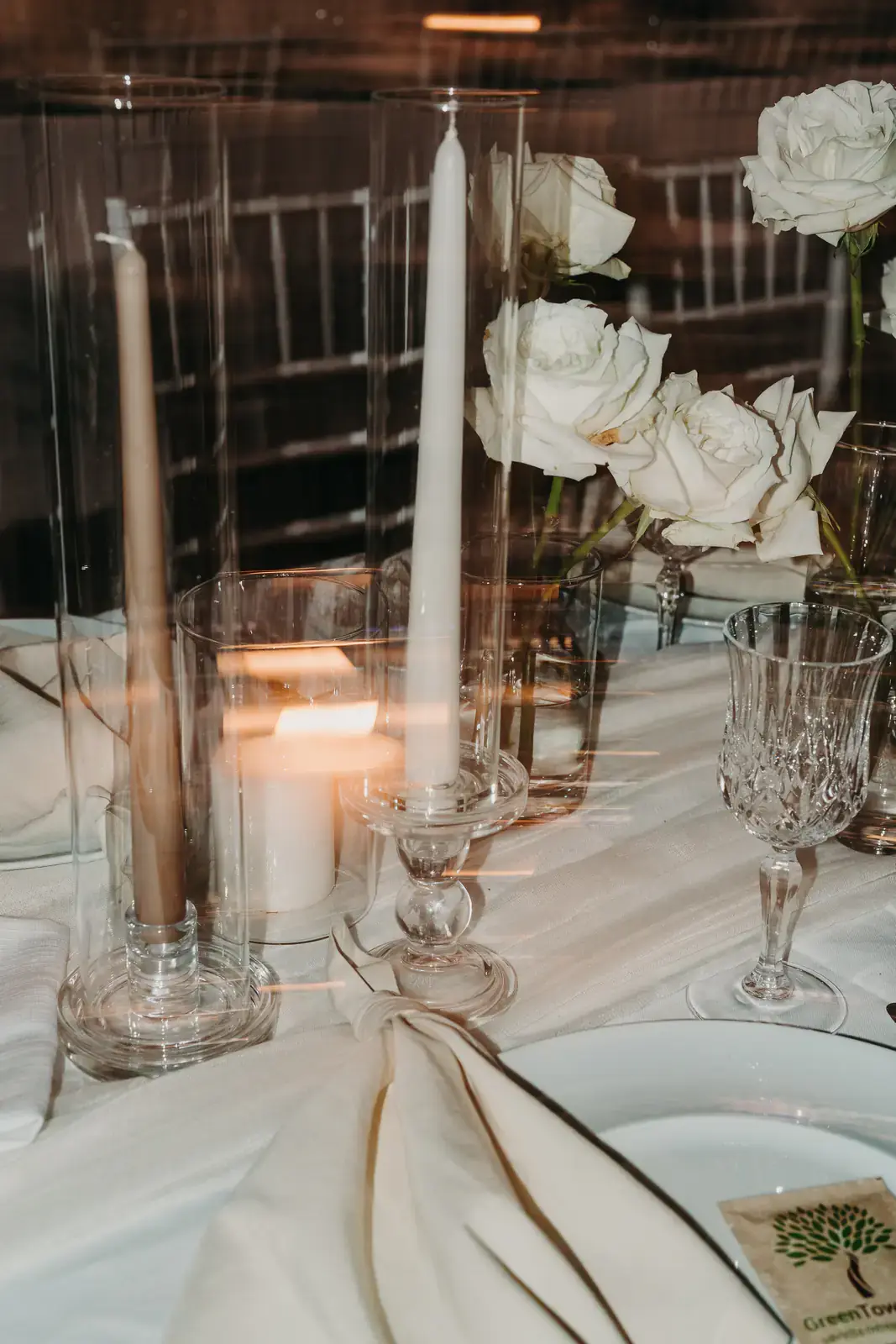
A flame inside a glass
The honey-coloured light of a flame seen through a glass tumbler, reflected in the crystal beside it. In the evening, at the table, that light does almost everything: it warms faces, makes the cutlery shine, softens the white of the cloth. A wedding table, though, is not a painting to look at. It is where your guests will spend hours eating, talking and raising glasses. First it must be comfortable, then it can be beautiful.
At the masseria, dinner is usually in the Corte Grande, the large stone courtyard, under the luminarie, the traditional Apulian festival lights, beside the trullo. Summer evenings on the Murgia plateau, inland in northern Puglia, are long and spent outdoors, so almost everything below assumes an open-air table.
The place setting, without fear
‘Mise en place’ is French for the arrangement of plates, cutlery and glasses at each seat. The rules are few, each with a practical reason:
- Forks on the left, knives on the right, blades facing the plate; the spoon, if needed, beside the knives.
- Cutlery is used from the outside in, in the order of the courses: guests know where to start without asking.
- Glasses at the top right: water and wine, usually no more than three or four. The glass for the bubbles can arrive with the toast.
- The bread plate at the top left, with its small knife.
- The napkin on the plate or to the left, never inside the glass.
- Space: each place needs room to breathe, usually around sixty centimetres. Ask how it is calculated before deciding how many to seat at each table.
The centrepiece: low or very tall, never in between
The easy rule is just one: low or very tall; never at eye level. An arrangement kept under about thirty centimetres lets guests see the person opposite; one raised on a slim stand, opening above their heads, leaves the view free below. Anything in between becomes a wall, and dinner is spent talking to a hydrangea.
Then there is space. Between plates, glasses, bread, bottles and carafes, a table fills up fast: decorations should take no more than a third of it; the rest is for eating. On long tables, rather than big separate arrangements, a continuous line of small vases, branches and candles down the centre works better, with a rhythm: one fuller vase, two small ones, a candle, and again.
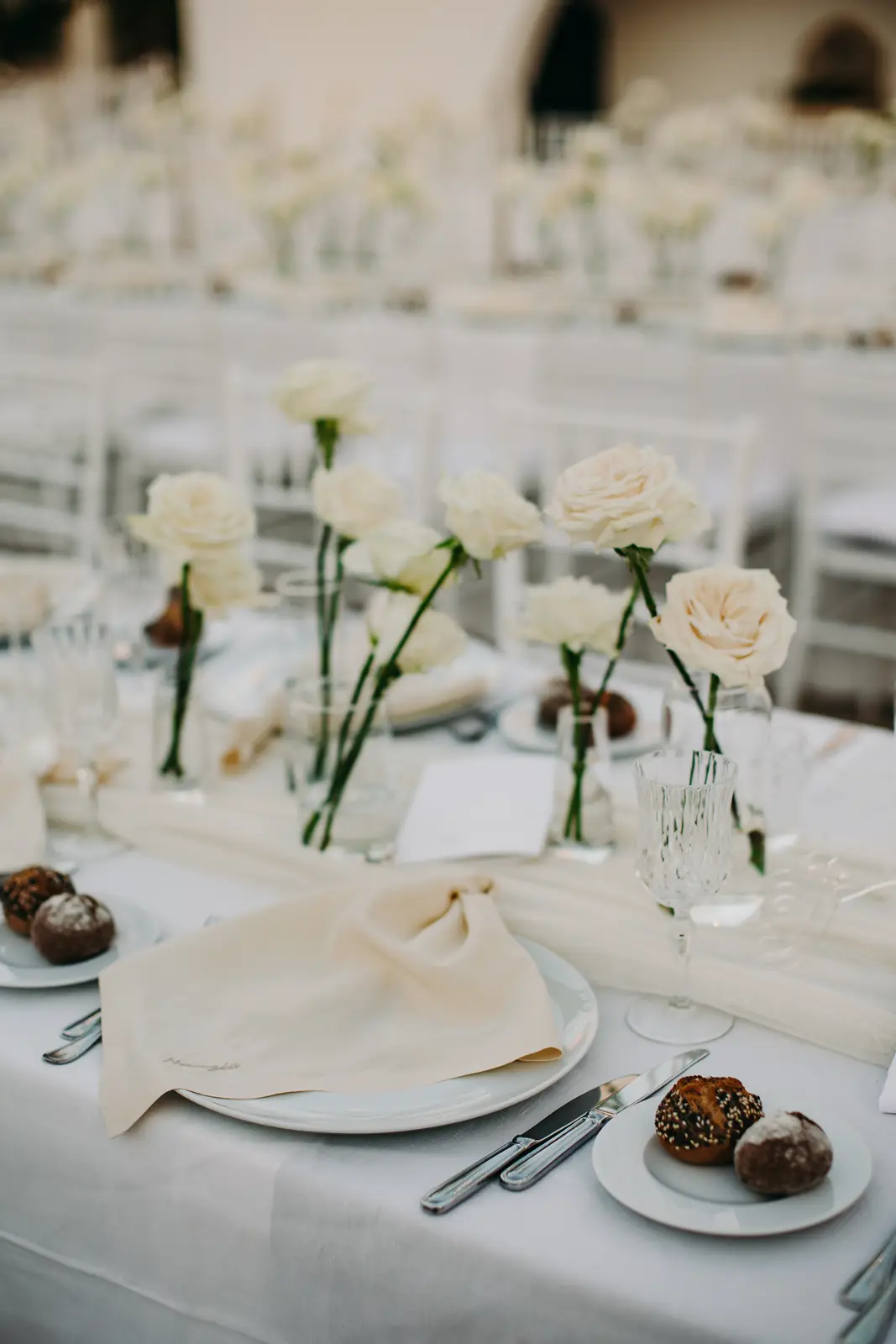
Yes: white roses in glass jars, olive sprigs laid on the cloth, candles at different heights. Better not: wide domed arrangements the size of a hat in the middle of a round table, which make guests lean sideways to see each other. And no strongly scented flowers such as lilies: they cover the scent of the food and the wine.
Light at several heights
A well-lit table has light at different levels, like a room at home: low down, small tealights in glass votives; in the middle, tapers in candlesticks or inside glass hurricanes; above, light from overhead, whether a string of bulbs through the trees or, in the Corte Grande, the luminarie. Everything at one height flattens the table; alternate, and it gains depth.
The colour of the light matters too. If you use electric light, choose warm white, around 2,700 kelvin on the packaging, close to the colour of a flame. Cold, bluish light turns skin grey and food uninviting.
Candles outdoors: breeze, timing and one person in charge
On the plateau, away from the sea, evenings are often breezy: a light wind is enough to blow out a row of open candles, or worse, to bend a flame towards a napkin. A few precautions:
- Candles always protected: inside tumblers, cylinders or lanterns taller than the flame. Where the wind is strong, or near children, use warm-white LED candles: in the evening, from a metre away, you can hardly tell.
- Flames away from greenery and fabric: dry branches, olive leaves, napkins and drapes must not touch the glass.
- Lit shortly before guests arrive, not an hour earlier: a candle lit too soon is spent by dessert.
- One person in charge: who lights them, who checks them during dinner, who puts them out at the end. Decide it beforehand, with a name.
- No scented candles on the table: like strong flowers, they cover the food and the wine.
See it before you decide
Before the day, ask whoever dresses the tables for a photo of one complete place setting, with cloth, plates, glasses, centrepiece and candles, ideally in evening light. You see at once the glasses that do not fit and the flowers that hide too much. The table should speak the same language as everything else: the words of your wedding concept, the colours of your mood board, and the same paper as the menus and place cards, which I cover in the wedding stationery suite. If you would like to see the courtyard before you decide how to lay it, ask us for a visit; for the light at each hour, read sunset times for wedding photos.
- L'esperienza della famiglia Alicino con i matrimoni in masseria · Tenuta Montevitolo · novembre 2026
- Dati aziendali confermati dalla famiglia Alicino · Tenuta Montevitolo · settembre 2026