What food is served at a wedding in Puglia? A chef's guide to the Apulian wedding menu
An Apulian wedding usually opens with a long aperitivo of local food, such as burrata and mozzarella, focaccia and taralli, fried snacks, cured meats, seasonal vegetables and often raw seafood, followed by a seated dinner of starters, pasta, a main course and dessert, and then the cake. The best menus follow the season and choose a few regional dishes done well, rather than trying to fit in everything. At Tenuta Montevitolo the kitchen and the pastry are in-house, menus are tailored to each couple, and the vegetables come from a kitchen garden 50 metres from the kitchen.
Start from the season, not from the dish
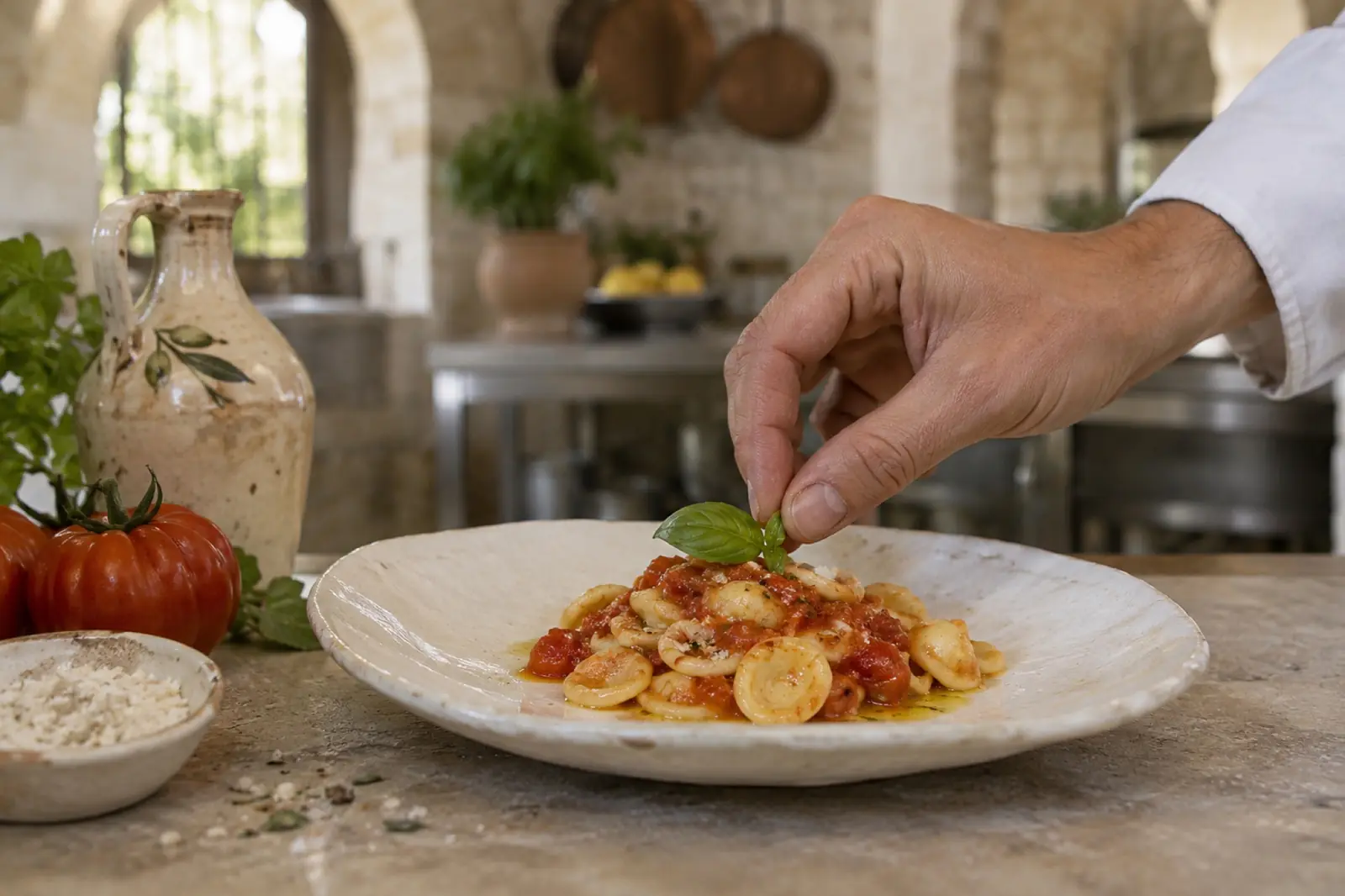
A plate of orecchiette with cime di rapa in July is a mistake, even if it is your favourite. Orecchiette, ‘little ears’, are the pasta of Puglia, made from durum wheat semolina and shaped one by one with the thumb. Cime di rapa, turnip tops, are a winter green: in summer you simply cannot find good ones. So when a couple sits down with me to talk about food, my first question is not ‘what do you like?’ but ‘when are you getting married?’
I am Leonardo Di Pinto, the chef at Tenuta Montevitolo, a masseria (a historic farm estate) in the countryside of Andria, northern Puglia. The Apulian larder changes every season: broad beans and wild asparagus in spring, tomatoes and aubergines in summer, cardoncello mushrooms from the Murgia and the new olive oil in autumn, turnip tops and pulses in winter. A menu built on what is in the fields can be tasted from the first bite.
The aperitivo: Puglia on a long table
In Puglia the aperitivo after the ceremony is not a few canapés. It is the first time the guests meet, it usually lasts an hour or more, and it has real food. At our masseria it usually happens in the vineyard, at sunset. These are the families of flavours that work:
- Fresh cheeses: mozzarella, stracciatella (strands of fresh curd in cream) and burrata, a pouch of mozzarella filled with stracciatella, which was born in Andria. It is best eaten the day it is made, not straight from the fridge.
- Bread and baking: focaccia; taralli, small ring-shaped crackers; friselle, twice-baked bread dressed on the spot; Altamura bread, a PDO bread from the same Murgia plateau.
- Fried food: panzerotti, small fried turnovers usually filled with tomato and mozzarella; sgagliozze, squares of fried polenta; popizze, balls of fried dough.
- Cured meats and cheeses: capocollo from Martina Franca, caciocavallo, canestrato pugliese.
- Seasonal vegetables: grilled, preserved in oil, or just blanched and dressed with extra virgin olive oil.
- Crudo di mare, raw seafood: oysters, mussels, prawns, and sea urchins in their season.
Here is my first piece of advice, as an honest cook: the aperitivo should open the appetite, not close it. Choose two or three families and do them well. A cheese counter, fried food made to order and some seasonal vegetables already make a true Apulian aperitivo. Raw seafood is wonderful, but it must come from a certain source and be handled as European rules require for fish eaten raw, including freezing beforehand. It is not for everyone: pregnant guests and small children usually avoid it, so always put something cooked beside it.
The dinner: what usually comes to the table
Then everyone sits down. An Apulian wedding dinner is usually served at the table, and follows the Italian order of courses: an antipasto (starter), a primo (a pasta or rice dish), a secondo (fish or meat) with its side dish, and dessert, before the cake. The primo might be fresh pasta with tomato or with seafood; a secondo might be oven-baked fish with potatoes, lamb, or bombette, small rolls of pork filled with cheese, a speciality of the Valle d'Itria further south.
Old Apulian banquets were famous for courses that never ended. I will be frank: they often ended with half-full plates going back to the kitchen. Four courses done well are better than eight rushed ones. After a generous aperitivo, that is plenty. And at the end come the confetti, sugared almonds, which you will find at every Italian wedding.
How we build a menu at Montevitolo
At the masseria the kitchen and the pastry are our own, and every wedding menu is made to measure: we start from what you love and from what the season gives. In the glasses there are the wines of the estate's cellar; on the table, the extra virgin olive oil of the family's mill, made from Coratina olives.
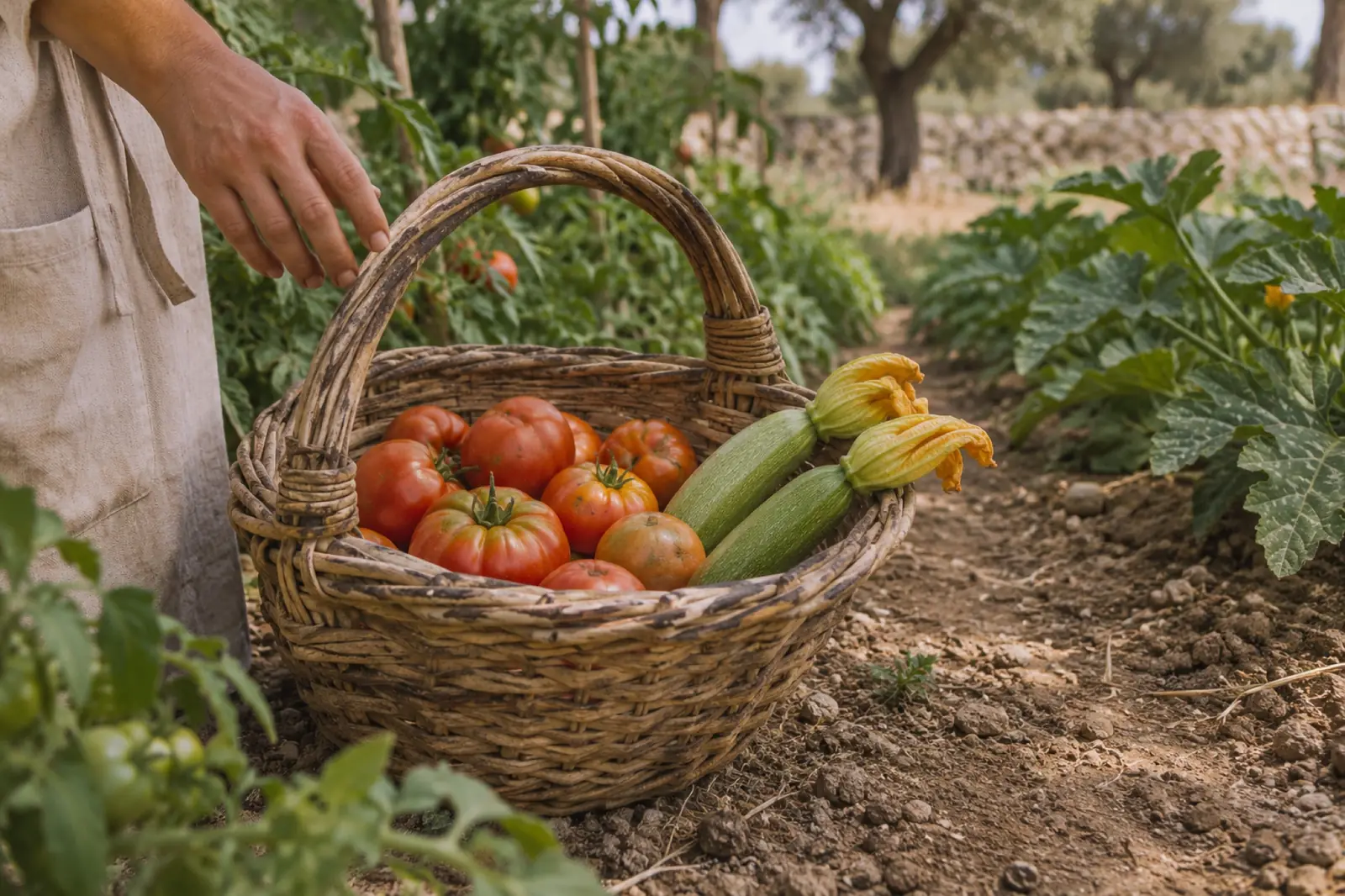
People talk about ‘zero-kilometre’ food, meaning local produce that has not travelled. Here we can say zero-metre. The masseria's kitchen garden, looked after by Michele Centrone, our massaro (the farm keeper), is 50 metres from the kitchen. In summer there are tomatoes and courgettes, and when a sauce is needed, we do not open a jar: the cooks walk out, pick the tomatoes and bring them back to the pan with the oil. You can taste the difference.
A practical tip: what works almost every time is a mix. Buffets and live cooking stations at the aperitivo, when guests want to move around and talk, and a dinner served at the table, when it is time to sit down and raise a glass.
Allergies, diets and children
In the kitchen an allergy is not a detail: it is a different recipe. European law, Regulation (EU) No 1169/2011, lists 14 allergens that anyone serving food must declare, including cereals containing gluten, milk, eggs, nuts, peanuts, fish, crustaceans, molluscs, sesame and sulphites. In Puglia two of them turn up everywhere: gluten, because the Murgia is wheat country, and almonds, which are in many sweets and in the confetti.
Each couple's guests confirm through a personal link, and with their reply they tell us their diets and allergies; a group leader can confirm for the whole family, children included. Write it precisely: ‘milk protein allergy’ and ‘lactose intolerance’ are two different jobs for a cook. And think of the children early: simple food, served before the adults, so they eat when they are hungry.
If you would like to start thinking about your menu, send us your date: the family replies within two working days with availability and a tailored proposal.
- L'esperienza della famiglia Alicino con i matrimoni in masseria · Tenuta Montevitolo · novembre 2026
- Dati aziendali confermati dalla famiglia Alicino · Tenuta Montevitolo · settembre 2026
- Regulation (EU) No 1169/2011 on the provision of food information to consumers (Annex II: substances or products causing allergies or intolerances) · EUR-Lex
- Regulation (EC) No 853/2004 laying down specific hygiene rules for food of animal origin (Annex III, Section VIII: fishery products eaten raw) · EUR-Lex