Wedding day flow: how to avoid waiting and dead time between the moments
Guests rarely notice good flow, but they notice waiting at once: you avoid it by designing each transition, deciding for every change of scene where the guests go, who tells them and what they find when they arrive. The aperitivo, the Italian drinks hour between ceremony and dinner, should not run beyond an hour and a half, and elderly guests and children need seats, shade and a quiet corner from the start, not halfway through the party.
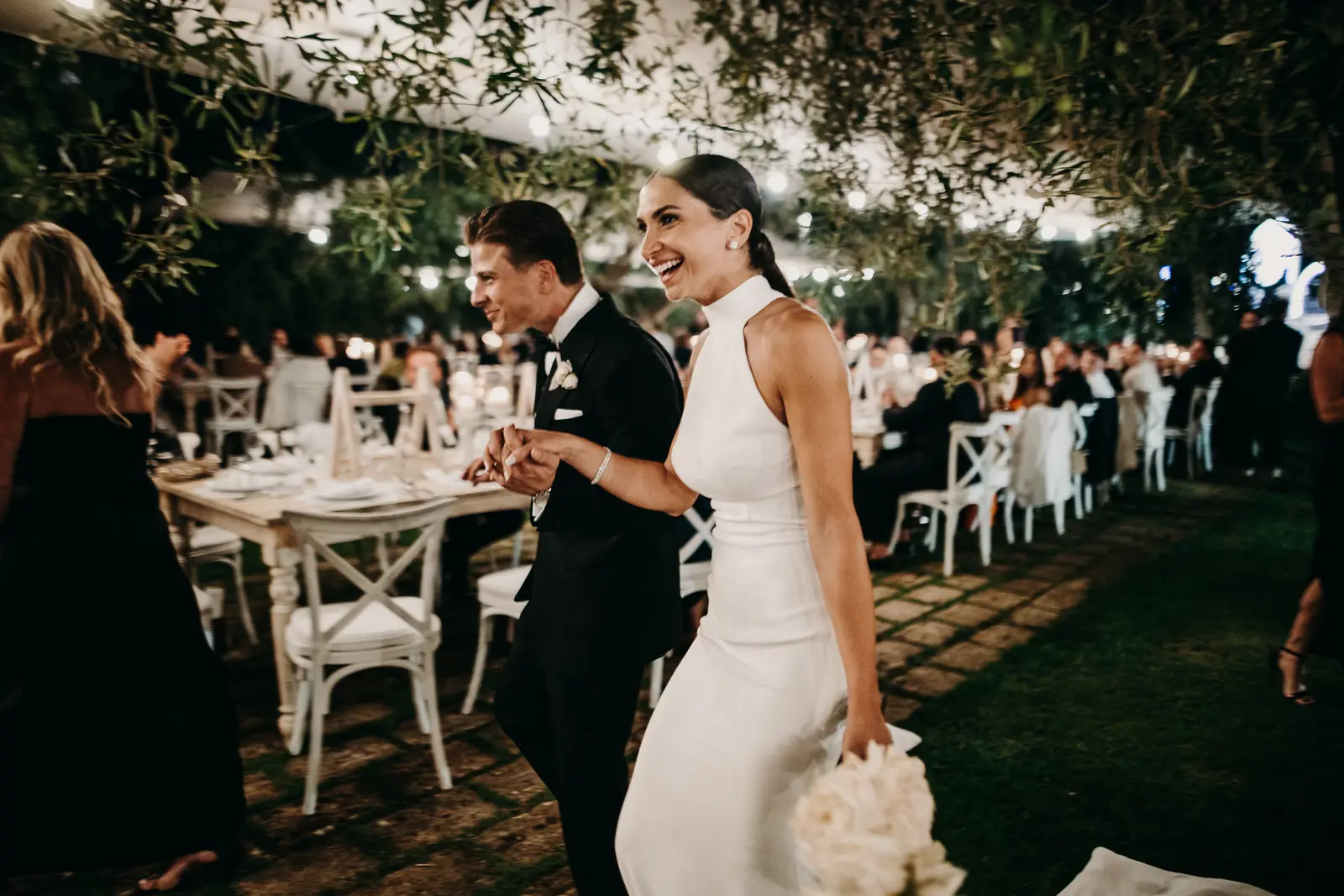
Forty minutes outside a closed door
Guests never notice good flow. They notice waiting straight away. Forty minutes on their feet after the ceremony, glass empty, the couple nowhere to be seen: that is what they talk about in the car on the way home. The flow of a wedding is made of transitions, not moments. You choose the moments. The transitions between them have to be designed, one by one.
At a destination wedding this counts double. Many of your guests will have flown into Bari, driven 50 minutes inland to the countryside of Andria, in northern Puglia, and arrived at a masseria, a historic farm estate, they have never seen. They cannot guess the order of the day: someone has to tell them.
For every change of scene, ask three questions: where do the guests go, who tells them, and what do they find when they get there? Any question left without an answer is where the waiting starts.
- Arrival to ceremony. Who welcomes people at the entrance, where they wait, when they sit down. Early arrivals should find water and shade, not an empty lawn.
- Ceremony to aperitivo. The trickiest one: congratulations, rice, the group photo, then everyone moves. The first glass must be ready when the first guests arrive.
- Aperitivo to dinner. Seats found without queuing: the seating chart in more than one place, names easy to find.
- Dinner, cake, party. Every change of place is announced, and the music walks people over instead of waiting for them at the other end.
The aperitivo: an hour, an hour and a half, no more
The rule we give every couple: the aperitivo does not go beyond an hour and a half. Enough for couple photos, greetings and the first toast; beyond it, people tire of standing, heels sink and hunger turns into impatience. If the photos keep you away for more than forty minutes, it is the timeline that needs fixing, not your guests' patience.
Here the aperitivo is usually in the vineyard at sunset. Even there you need seats for those who would rather sit, and shade for the first twenty minutes, when in summer the sun is still warm. Mario times it in sunset times for wedding photos; Leonardo, our chef, covers the food in wedding food in Puglia.
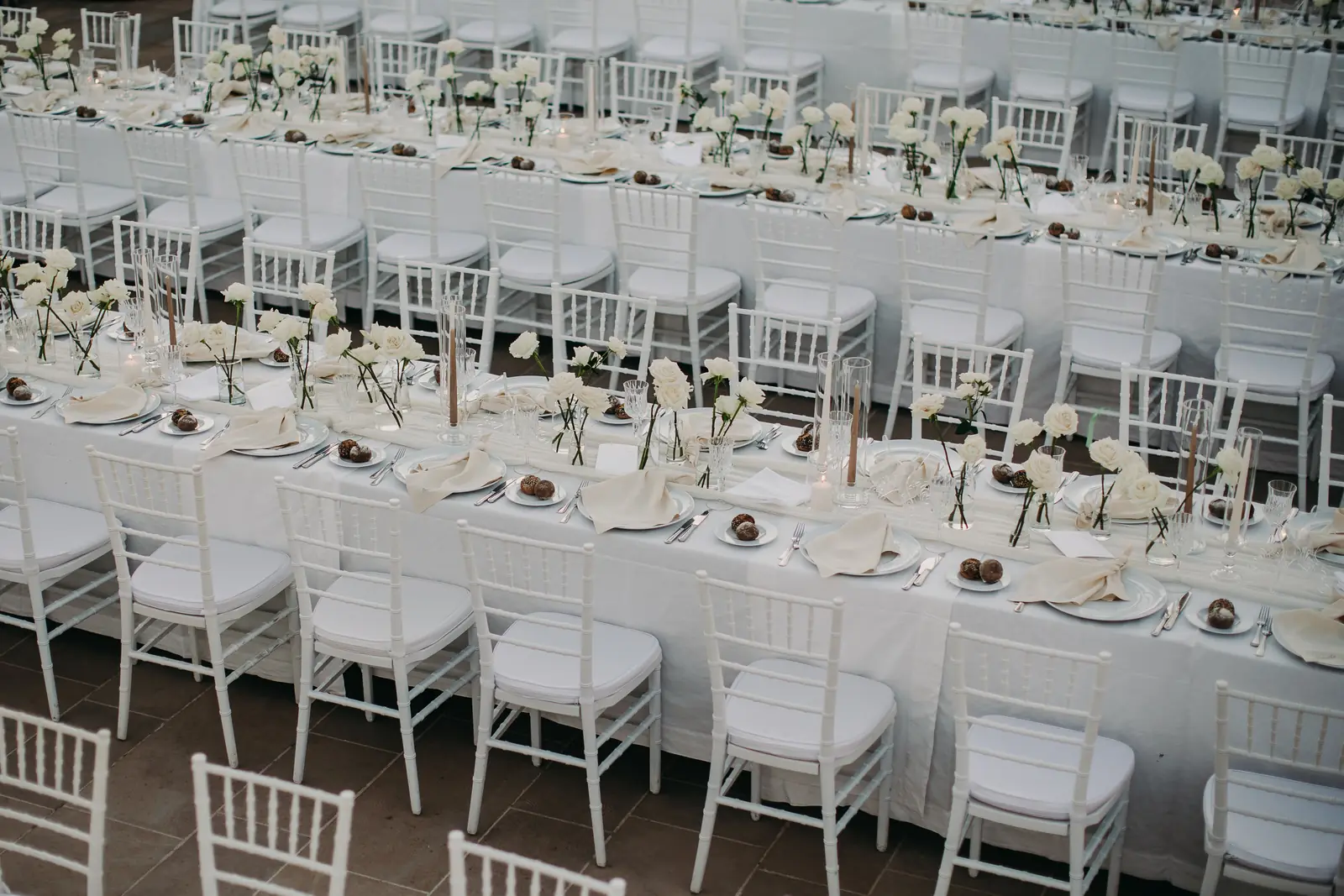
Guests should know, not ask
A guest who knows what comes next waits happily. One who does not asks everybody, starting with the waiter carrying a tray. Orientation starts before the wedding:
- The programme in their pocket. The programme of the day is in the couple's private area, and the guests' app puts it on their phones via a personal WhatsApp link.
- Questions answered once. In the app guests ask their questions and the answers are visible to everyone: «What time does the shuttle leave?» is answered once, not thirty times.
- The welcome. On arrival, check-in on a tablet shows who is already here; whoever welcomes them says where to go.
- Signs. Few, clear, wherever the path changes. A sign at nine in the evening needs lighting.
- Announcements. One person, one sentence: «In ten minutes we move to dinner.» No surprise microphone. If your guests speak two languages, say it in both.
Those who need it most, first
Plan comfort from the start, through the eyes of whoever finds the day hardest.
- Elderly guests: real chairs in every place of the day, aperitivo included; short paths, no steps where possible, someone to walk with them when everyone moves.
- A quiet corner: somewhere away from the music to talk, feed a baby or rest for ten minutes.
- Children: one adult in charge, something to do while they wait, dinner served early. A bored child at ten in the evening is the whole table's problem.
- Guests with limited mobility: tell us with the RSVPs, not on the day, so the route can be planned.
Backstage: one event, one plan B
Flow nearly always breaks for one of two reasons: someone else needs the same space, or the weather changes. We host one event a day, with every space reserved for the couple, so no other party needs your room. And every moment has its plan B: if the weather turns, the party moves, it does not stop. The rest of the day is in our masseria wedding venue near Bari.
Four things not to do:
- Do not keep seated guests waiting for the couple more than a quarter of an hour: that is when they check their watches.
- Do not put all the speeches in a row: three at most, each in its own moment.
- Do not move everyone to a place five minutes' walk away without telling them first: whoever wore the wrong shoes will remember.
- Do not leave the photographer out of the timeline: photos need their slot too, as I explain in choosing a wedding photographer.
If you would like to see how a day flows here, write to us to arrange a visit: we reply within two working days. For the pace of each moment, read the music, moment by moment.
- L'esperienza della famiglia Alicino con i matrimoni in masseria · Tenuta Montevitolo · novembre 2026
- Dati aziendali confermati dalla famiglia Alicino · Tenuta Montevitolo · settembre 2026